
Why press freedom isn't delivering truth
Below is a republished speech I delivered to a Palestine Solidarity rally in Auckland on May 2, on the theme of World Press Freedom Day.

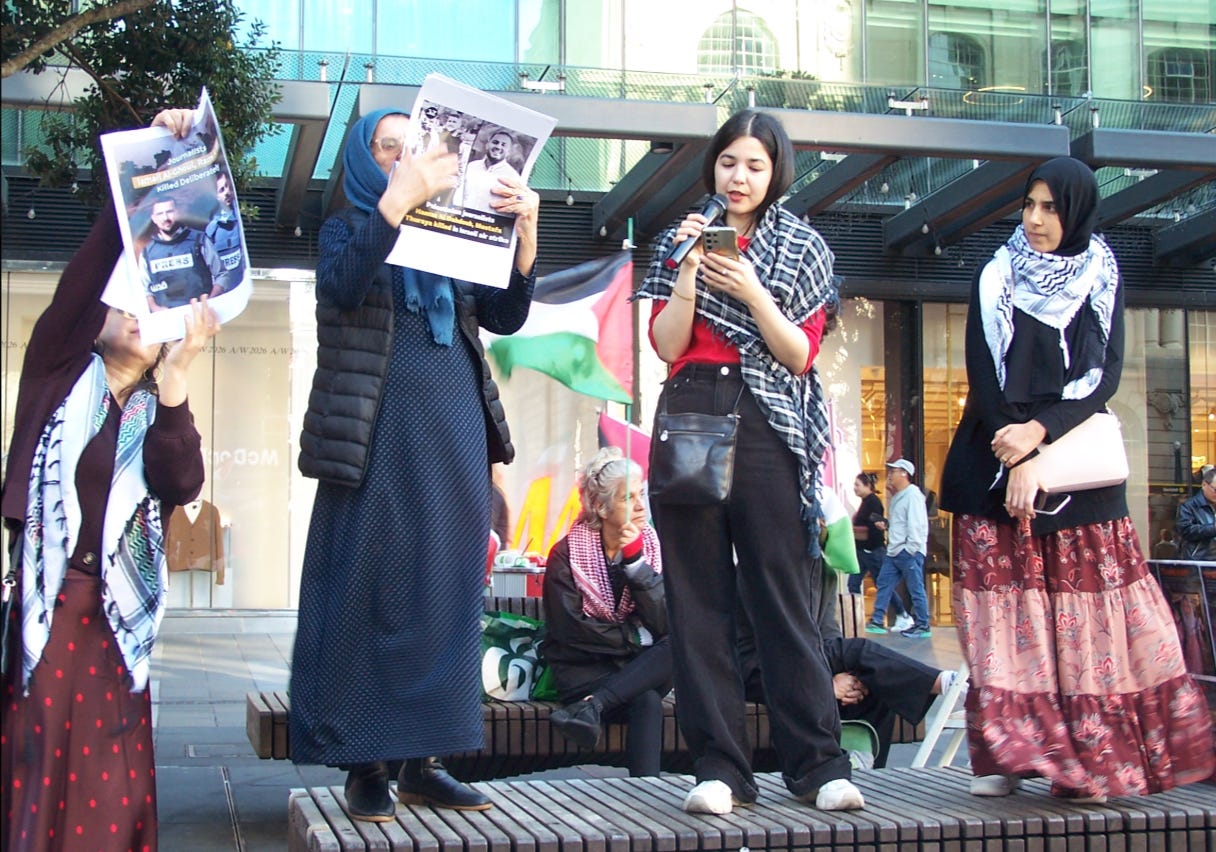
As people celebrate World Press Freedom Day, recognising the right of journalists and media groups to report without censorship, violence or hinderance, I’d like to take the opportunity to point out we have very little to cheer on.
The event was launched by the United Nations in 1993 to highlight the importance of a free and independent media around the world and to raise awareness of the threats facing it. The theme this year is Shaping a Future at Peace, which advocates for a journalism that plays a key role in peace-building.
A conference in Zambia is now being co-hosted by the UN to look at how journalism can achieve this, namely through presenting accurate information and building public trust, by encouraging dialogue instead of conflict and by holding power accountable to prevent instability in the world.
Delegates will look at how journalism intersects with technology, human rights and what it calls ‘global security challenges’.
This theme is timely, for if we look at how mainstream media in the West continues to operate, it is clearly failing to push a preferential option for peace in any meaningful sense.
In particular, it continues to report in a manner that fails to contextualise the imperial conflicts now raging across the world.
This is no more evident than in the way media reports on west Asia, where Israel has been committing genocide in Gaza and continues to ethnically cleanse Lebanese from their land as part of its greater Israel project. This of course is being done with the full support of the collective West, as the US pursues broader geostrategic interests.
It is evident in the way an illegal war of aggression against Iran and its people has been presented. No mainstream media, including our public broadcasters, have used this correct terminology without unneeded attribution, as if ‘aggression’ is merely one claim among many. Our state broadcasters continue to refuse to adjudicate what they call contentious claims, even though the evidence exists, in this case by simply referencing the UN Charter.
The war against Iran constitutes the ‘supreme international crime’, as the Nuremberg Tribunal called it. Acts of piracy targeting oil tankers leaving the Strait of Hormuz are also acts of an illegal war, now threatening to wreck the global economy, a situation that will impact on the most vulnerable in every nation, including our own.
The media is failing to report in a manner that points to an overarching strategy to maintain US imperial hegemony over the planet, as other nations seek to pursue their economic sovereignty in an emerging multipolar world.
This broad omission is a failure to hold power to account, obscuring the nature the so-called ‘rules-based international order’.
Far from our media maintaining institutional distance from this system, it acts as its epistemic tool.
To this end, our news room leaders impose institutional practices that masquerade as standards, as balance and impartiality, but in effect put insidious structural constraints on what reporters can and cannot state in reporting. This is what the Gaza genocide has revealed and what the latest aggression against Iran and Lebanon is teaching us further.
In the years since October 7, one example among many remains with me. In late 2023 our Palestinian brother Tameem Shaltoni was interviewed by Radio New Zealand (RNZ) as part of a podcast on the conflict in Palestine.
After it went on air, Tameem complained that several references to what he called ‘unfolding genocide’ had been removed. When an activist platform reached out directly to the public broadcaster’s head of content Megan Whelan for an explanation, they were told that including the references “would have stolen valuable time”.
Whelan said it would have involved contextualising the claim and explaining to listeners what genocide was.
Over a year later, our broadcaster commissioned a report into its coverage of Gaza. Its author found nothing wrong with RNZ’s coverage, including its use of foreign news copy.
He glibly explained that Western media’s pattern of reporting of Israeli perspectives above those of Palestinians’, was due to Israel’s western ‘alignment’, giving it greater ‘news proximity’ to a New Zealand audience, something editors took into consideration.
The idea that it we are naturally more interested in the lives of European colonial settlers, than the lives of oppressed Palestinians, deeply offends our humanity. It reveals a sickness within our societies that permeates our newsrooms.
In acting in this manner, media do not build public trust, as they justify overlooking the real sources of instability in the world. They have failed to inform the public of genocide and colonial domination in the way that could have created a moral and practical compulsion to hold our politicians to account over foreign policy. It is clear they are not fulfilling the informational needs of democratic citizenship here, or anywhere else in the West.
To make matters worse, they uncritically platform those on thinktanks aligned with Washington, many funded by the military and US agencies.
How is this helping to build peace and stability?
The last time I addressed this rally, I referred to the work of Palestinian Anas al-Sharif, a journalist who was assassinated along with four of his Al Jazeera colleagues last August. Since then, other journalists have lost their lives at the hands of Israeli war criminals, killed because their reporting contradicted and confronted Zionist, US and European propaganda.
Lebanese journalist Amal Khalil was another exemplar of professional truth telling, targeted in a follow-up airstrike in south Lebanon last month as she took shelter alongside colleagues.
Amal was reported to be the ninth journalist killed in Lebanon this year.
These journalists maintained a fidelity to the truth and to the public’s right to know. They therefore knew they risked assassination. In this sense, they enjoyed little media freedom, yet choose to risk everything.
Such steadfastness contrasts sharply with the journalism here in New Zealand, where there are much more protections for journalists.
To coincide with World Press Freedom Day, NGO Reporters without Borders presents indexes each year pointing to far greater press freedoms in western countries, than in the Global South, in places like Iran, Pakistan, or China.
Yet, when we look at the coverage, media in these Global South nations have covered events in west Asia for more accurately, many contextualizing conflicts around the globe based on an implicit structural analysis that correctly puts imperialism at the centre of events.
Any assumption that these stated media ‘freedoms’ automatically bring more accurate and less skewed reporting, is patently false. The situation is much more nuanced. Such narratives rest on the assumptions and prejudices of liberal imperialists who occupy our political and information spaces.
We need to be very careful here, least we fall prey to the old western Orientalism that assures us that we are democratic standard bearers to the rest of the world. Many still labour under a false idea that our liberal democracies are superior to other systems in the world, even as heavily-propagandised countries like Germany, the UK and Australia, become increasingly war-like, repressive and our societies crumble.
The words of US scholar Michael Parenti come to mind. Parenti famously said: “People who think they’re free in this world just haven’t come to the end of their leash yet.”
How many journalists in this country have never seen the end of their leash? I’d argue quite a few and that’s increasingly unacceptable.
The US is preparing a new assault on Iran as it attempts to gather a coalition to help it, including NZ.
Europe’s vassal states continue to push escalation and a direct confrontation with Russia, risking nuclear war, instead of pursuing peace through diplomacy. Our government is supporting it.
The US is devising a naval choke chain across China’s key trade routes to contain its peaceful and legitimate economic growth, pushing militarisation in the Asia-Pacific region hoping to use countries like New Zealand to yank on that choke chain when the time comes.
Japan is being encouraged to remilitarise, a country previously sworn to pacificism after its horrific crimes as part of the axis of fascism.
Reporters should be running furiously with these stories, dragging their complicit news managers behind them on the other end of their leashes.
History will judge them harshly if they don’t in some manner attempt to break through the constraints that exist within their institutional media settings.
They must use language and present stories free of the narrow and distorting lens of our extremist ideologies - of neoliberalism and imperialism.
The fact is New Zealand is falling in line as the US attempts to shore up its hegemony in much more brutal and direct ways.
If journalists do not have the space to frame events in Palestine, Lebanon, Iran, Cuba, Venezuela and Europe, as the structural violence of imperial power, there is no authentic press freedom.
It is instead, the freedom to self-censor, the freedom to obscure, the freedom to present false balance, the freedom to decontextualize, the freedom to sit on the fence. Press freedom does not then serve the public interest. It serves interests of a tiny western power elite that cares little for humanity or peace.
Great analysis, it's a breath of fresh air to read an article that provides so much context on this critical issue of press freedom and the consequent information we have access to. The myth of western nations embodying freedom needs to be confronted every day, good on you for doing that. As Arundati Roy said, this myth has been buried under the rubble along with the children in Gaza, and yet their powerful propaganda machine allows it to persist.
A brilliant analysis on the rather sad state of our media today